
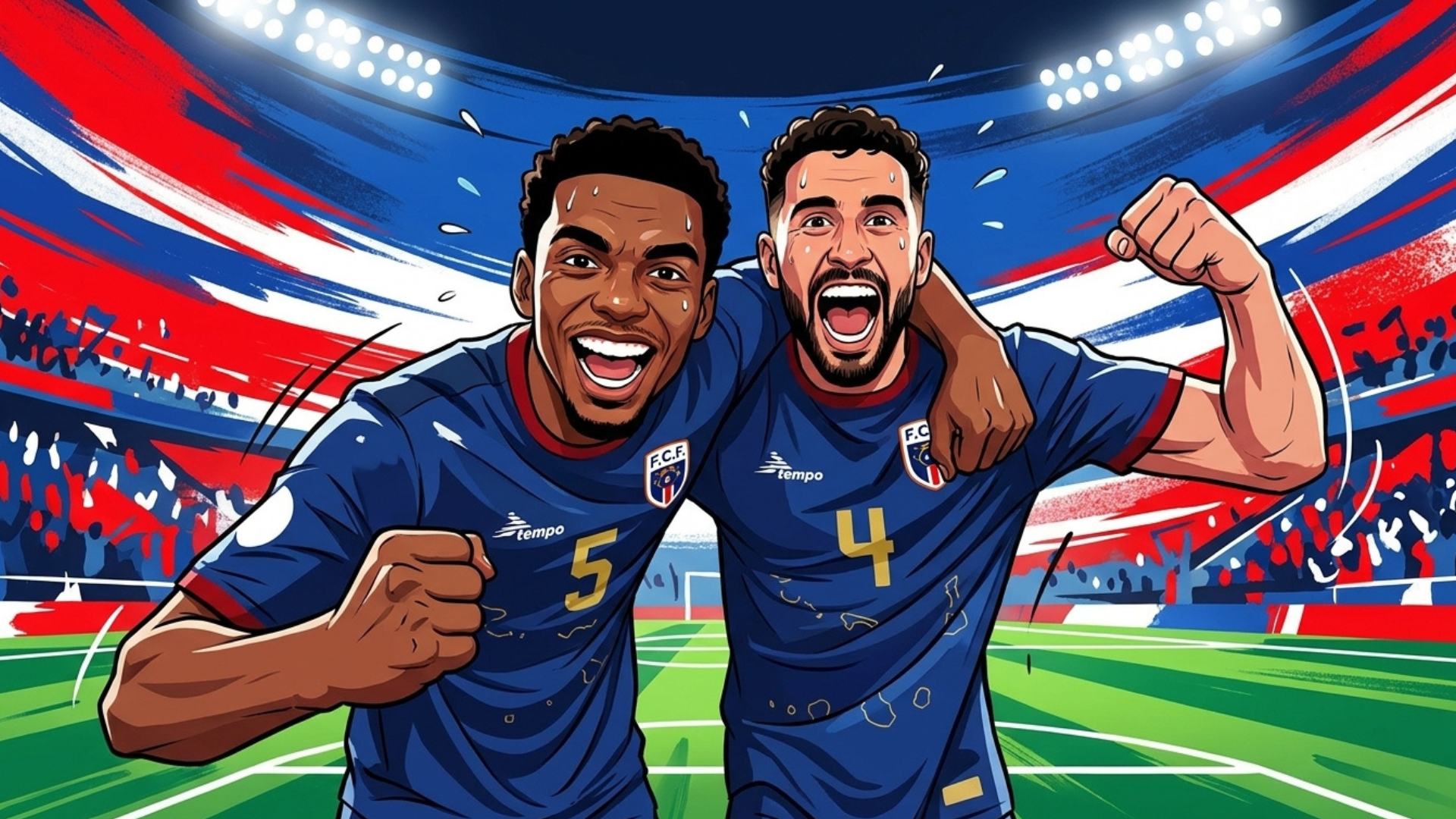

Cape Verde were making their World Cup debut in 2026, with a population of little more than half a million.
They were not the smallest country ever to qualify. Curaçao took that record at the same tournament, but Cape Verde soon made history of their own by becoming the smallest nation by population to progress from a World Cup group.
They did it without losing.
Their first World Cup match was against eventual champions Spain. One team contained players from Barcelona, Real Madrid, Arsenal and several of Europe’s biggest clubs. Cape Verde’s squad had been assembled from places including Chaves, Shamrock Rovers and leagues stretching from Portugal to the UAE.
The match finished 0-0.
Next came Uruguay. Kevin Pina scored Cape Verde’s first World Cup goal, Hélio Varela added another and the Blue Sharks earned a 2-2 draw.
A second goalless draw, this time against Saudi Arabia, was enough to send them through as Group H runners-up.
Three matches. Three draws. No defeats.
Their reward was Argentina.
Cape Verde Shook Argentina
On paper, the Round of 32 looked like the point where Cape Verde’s tournament should end.
They had already made history and survived a group containing Spain and Uruguay. Now came Argentina, the defending world champions.
Argentina eventually won 3-2, but they needed extra time to do it.
Deroy Duarte scored in the 59th minute to make it 1-1 and Cape Verde refused to disappear. Then, in the 103rd minute, came their biggest moment of the tournament.
Sidny Lopes Cabral collected the ball outside the area and curled a superb effort from around 25 yards beyond Emiliano Martínez and into the top corner.
It was 2-2.
Cabral immediately went over the advertising boards to celebrate with his mother in the crowd. The strike was later voted the best goal of the 2026 World Cup.
Argentina eventually found a winner, but Cape Verde had taken the holders deep into extra time and came within 17 minutes of a penalty shootout.
With the tournament over, attention inevitably turned to what might happen next to the players who had caused such a shock.
The answer, in most cases, was not very much.
Trabzonspor Had Already Signed Sidny
Cabral looked like the obvious candidate for a big post-World Cup move.
He had scored the goal of the tournament against Argentina and had one of the more unusual backgrounds among the players suddenly attracting worldwide attention.
Before Benfica took him to Portugal, Cabral had been playing for Viktoria Köln in Germany’s 3. Liga. Earlier in his career, he had been much further down the German system.
Within a few years, he was scoring against Argentina in a World Cup knockout match.
Anyone hoping to sign him after the tournament was already too late.
Trabzonspor had completed a permanent deal with Benfica in early June, before the World Cup began, and handed Cabral a five-year contract.
By the time millions watched him bend that shot beyond Martínez, his next club had already been decided.
Trabzonspor’s timing suddenly looked very good.
Where Is Cape Verde Goalkeeper Vozinha Now?

Perhaps the strangest post-World Cup story belonged to Vozinha.
Cape Verde’s 40-year-old goalkeeper entered the tournament without a club.
Vozinha was outstanding in the 0-0 draw with Spain and remained an important part of a side that went through the group unbeaten. Against Argentina, he was busy again as Cape Verde kept the game alive deep into extra time.
His performances earned him a nomination for the 2026 Yashin Trophy.
Colo-Colo then signed him as a free agent, taking him to one of Chile’s biggest clubs.
So, in the space of one summer, Vozinha went from being a 40-year-old goalkeeper without a club to a World Cup cult figure, Yashin Trophy nominee and Colo-Colo player.
That is quite a way to find a new employer.
Where Are Cape Verde’s World Cup Players Now?
Considering the attention Cape Verde attracted, the transfer market response was fairly quiet.
Their squad arrived at the World Cup valued at around £47 million. Plenty of leading European clubs now spend more than that on one player.
Against Argentina, the difference in individual market value was enormous. It did not look quite so large on the pitch.
Several Cape Verde players changed clubs after the tournament, but most deals involved free transfers, returns from loans or modest fees.
Even Cabral, whose goal against Argentina made him one of the faces of the tournament, had already agreed his move to Trabzonspor. Vozinha joined Colo-Colo for nothing.
There was no sudden Premier League scramble and no player whose value shot into the tens of millions.
The market still viewed them much as it had before the World Cup.
As individuals, that may have been fair.
As a team, Cape Verde had just shown they could compete with almost anyone.
Cape Verde Were No Team of Wonderkids
Age was another reason Europe’s biggest clubs were unlikely to start fighting over Cape Verde’s squad.
Their average age was around 29. Vozinha was 40, captain Ryan Mendes 36, Pico Lopes 33 and Jamiro Monteiro 32.
This was not a young side waiting for scouts to notice them.
It was a group of experienced professionals who had spent years playing in different countries, leagues and systems.
That experience helped at the World Cup.
Cape Verde knew when to sit deep, when to slow games down and when to attack the space left by better opponents. They rarely looked overwhelmed, even when they spent long periods without the ball.
But football’s transfer market works differently.
A brilliant World Cup at 21 can change a career almost overnight. A brilliant World Cup at 32 is far less likely to bring a huge fee or a long contract from an elite club.
Cape Verde did not arrive with a crop of future stars.
They arrived with footballers who already knew their jobs.
Better Than the Sum of Their Clubs
Looking through Cape Verde’s club careers only makes the World Cup run more impressive.
Logan Costa was the obvious exception, an established Villarreal defender and one of the most valuable players in the squad. Yet he did not play a minute, with his fitness managed during the tournament.
Pico Lopes had spent years with Shamrock Rovers. Ryan Mendes built his career across France, Turkey and the UAE. Other players came from similarly varied backgrounds.
There was no Lionel Messi figure dragging them through matches and no £100 million midfielder controlling everything.
Cape Verde were simply a very good National side.
They stayed compact, defended with discipline and carried enough threat to punish opponents when chances appeared. Against Spain and Argentina, the difference in club status was much clearer on the team sheet than it was during the game.
Even coach Bubista’s next move fitted the pattern. After taking Cape Verde into the World Cup knockout stages, he joined Renaissance Berkane in Morocco rather than receiving a job at one of Europe’s major clubs.
The World Cup had not revealed a squad full of hidden superstars.
It had shown what a well-organised group of experienced players could do together.
Back to Reality
Within weeks of the Argentina game, Cape Verde’s players were scattered across club football again.
Cabral was with Trabzonspor. Vozinha headed to Chile. Jovane Cabral went to Brazil. Monteiro remained in the Netherlands, while others returned to Portugal, the UAE and clubs well away from the Champions League spotlight.
There was no sudden rush to sign half the squad.
And perhaps that is the point.
Cape Verde really were what they appeared to be: experienced professionals from a wide range of clubs who, when brought together, became an extremely good international team.
For one summer, they were good enough to hold Spain, go unbeaten in their first World Cup group and stand level with Argentina after 103 minutes of a knockout match.
Cape Verde’s World Cup was never about one player becoming a superstar.
It was about a team with very few of them playing like one.

