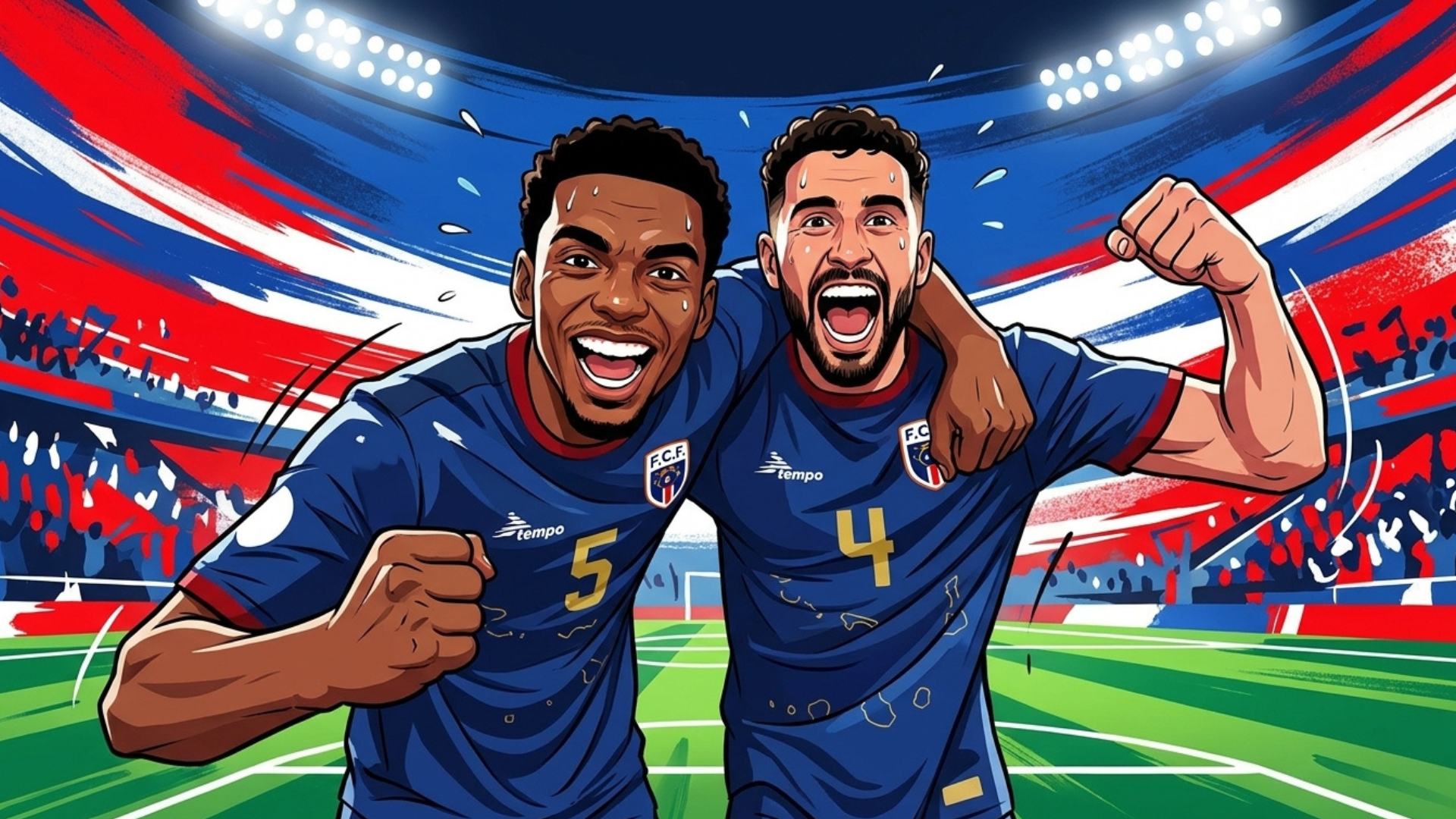
When Cape Verde’s players gathered around a mobile phone on the pitch in Houston, the match they had just played was only half the story.
Their own job was done. A tense 0-0 draw with Saudi Arabia had kept them alive. Now they needed one more result to go their way. Spain had to beat Uruguay.
When confirmation came through that Spain had won 1-0, the waiting ended. The Blue Sharks were into the last 32 of the World Cup.
A country of just over half a million people had reached the knockout stage on its tournament debut.
That matters, because this is a record that needs careful wording. Cape Verde are not the smallest nation ever to play at a men’s World Cup. That honour still belongs to Iceland, who qualified in 2018 with a smaller population.
But Cape Verde have now gone one step further. They are the smallest nation by population ever to reach the knockout stage of a men’s World Cup.
For a country that had never even appeared at the tournament before 2026, it is a remarkable piece of football history.
Cape Verde, Three Draws And One Huge Record
Cape Verde came into the 2026 World Cup as debutants, drawn into Group H with Spain, Uruguay and Saudi Arabia.
On paper, it looked brutal.
Spain were one of the favourites. Uruguay brought history, pedigree and World Cup weight. Saudi Arabia had become a more regular presence on the world stage. Cape Verde, by contrast, arrived as the feel good outsiders.
They were not expected to be here for long.
Instead, they made themselves almost impossible to beat.
Their first match was a 0-0 draw with Spain, the 2010 world champions. Veteran goalkeeper Vozinha, aged 40, became one of the early stories of the tournament with a superb display.
Then came Uruguay. The two time world champions looked like the sort of side who should eventually overpower a new World Cup nation, but Cape Verde would not fold. They came away with a 2-2 draw and another point that suddenly made the group very interesting.
The final game against Saudi Arabia was tight, tense and often nervous. Cape Verde did not need style points. They needed to stay alive.
Another 0-0 draw did the job.
Three games. Three draws. Three points. No wins, but no defeats either.
In the end, that was enough to finish second in the group, behind Spain and ahead of Uruguay and Saudi Arabia.
The prize is a last 32 tie against reigning world champions Argentina in Miami.
Why This Is Different From Iceland
Iceland are still one of football’s great small nation stories.
They stunned Europe at Euro 2016, beating England in the last 16 and giving the world that famous Viking clap. Two years later, they reached the 2018 World Cup and became the smallest country ever to qualify for the tournament.
Their opening 1-1 draw with Argentina in Moscow remains one of the best World Cup moments of the modern era.
But Iceland did not get out of the group.
That is why Cape Verde’s achievement sits in a different place. Iceland showed that a very small country could reach the World Cup. Cape Verde have shown that a small country can reach it, survive the group and move into knockout football.
That is the step that changes the record.
Cape Verde have not erased Iceland’s place in history. They have added the next chapter to the same story.
The Blue Sharks’ Rise Was Not An Accident
Cape Verde’s success is not just a nice one off.
The national team has been growing for years, helped by a smart use of players with Cape Verdean roots who were born or raised overseas. Many developed in Portugal, France, the Netherlands and other parts of Europe before choosing to represent the islands.
That has given Cape Verde a player pool much bigger than its home population would suggest.
It also means the side is not quite as small in football terms as the population figure makes it look. This is a team built from an island nation and its wider community around the world.
Under Bubista, Cape Verde have become hard to play against. They are organised, patient and calm under pressure. They do not need lots of the ball to stay in a match.
Their 2026 World Cup has been built on clean sheets, blocks, saves and belief.
They have not blown teams away. They have worn them down. Against bigger names, that can be just as powerful.
Northern Ireland Set An Early Small Nation Mark
Long before Cape Verde, Northern Ireland showed what a smaller football nation could do at a World Cup.
At the 1958 tournament in Sweden, they reached the quarter finals with a population far smaller than the major powers around them.
Their group was difficult, featuring West Germany, Argentina and Czechoslovakia. Northern Ireland beat Czechoslovakia in the group, drew with West Germany and then beat Czechoslovakia again in a playoff to reach the quarter finals.
They eventually ran into Brazil, where a young Pele was part of a side heading towards greatness.
Northern Ireland’s 1958 run remains one of the great small nation World Cup campaigns. It came in a very different football age, with less money, less global scouting and far fewer players moving around Europe.
Cape Verde’s story is more modern, shaped by diaspora links and a wider talent base.
But the spirit is similar. A smaller nation walked into a tournament full of giants and refused to behave like a passenger.
Costa Rica And The Modern Underdog Model
If Northern Ireland belong to the old World Cup story, Costa Rica helped create the modern one.
In 2014, Costa Rica were dropped into a group with Uruguay, Italy and England. Many people had them down to finish last.
Instead, they topped the group.
They beat Uruguay, beat Italy, drew with England, then beat Greece on penalties in the last 16. In the quarter finals, only a penalty shootout against the Netherlands stopped them.
That Costa Rica team gave smaller football nations a clear plan.
Stay compact. Defend with discipline. Make the most of set pieces and rare chances. Trust your goalkeeper. Do not panic just because the other shirt has a bigger badge.
Cape Verde’s 2026 run has echoes of that.
Vozinha has been central, just as Keylor Navas was for Costa Rica. The shape has mattered more than the style. The players have accepted long spells without control of the ball, then still found enough courage to take their moments when they came.
Costa Rica had a population of around five million in 2014, much bigger than Cape Verde’s.
But in football terms, they helped set the modern plan for how an outsider can hurt the giants.
Why Cape Verde’s Record Matters
Some will argue that the expanded World Cup format makes this less special.
The 2026 tournament has 48 teams and a last 32 stage, so there is more room for surprise stories than there was in the old format.
That is true, but it should not be used to shrink what Cape Verde have done.
They still had to hold Spain. They still had to take something from Uruguay. They still had to cope with the pressure of the Saudi Arabia match, knowing one mistake could end the whole thing.
A bigger tournament opened the door. Cape Verde still had to walk through it.
The bigger point is that international football is changing.
Smaller nations are better organised than they used to be. Scouting is wider. Diaspora players are easier to find and bring into national teams. Coaches are more tactically aware. Fitness levels across the game are higher.
That does not make the World Cup easy. It just means the gap between the giants and the rest is not always as wide as it looks.
Cape Verde are proof of that.
They have not arrived as a romantic side story. They have earned their place in the knockouts by being stubborn, smart and hard to beat.
Whatever happens against Argentina, the record is already theirs.
Cape Verde, an Atlantic island nation of just over half a million people, are now the smallest country ever to reach the knockout stage of a men’s World Cup.
The next time someone says the World Cup is predictable, point them towards the Blue Sharks.
Three draws were enough to change their football history forever.